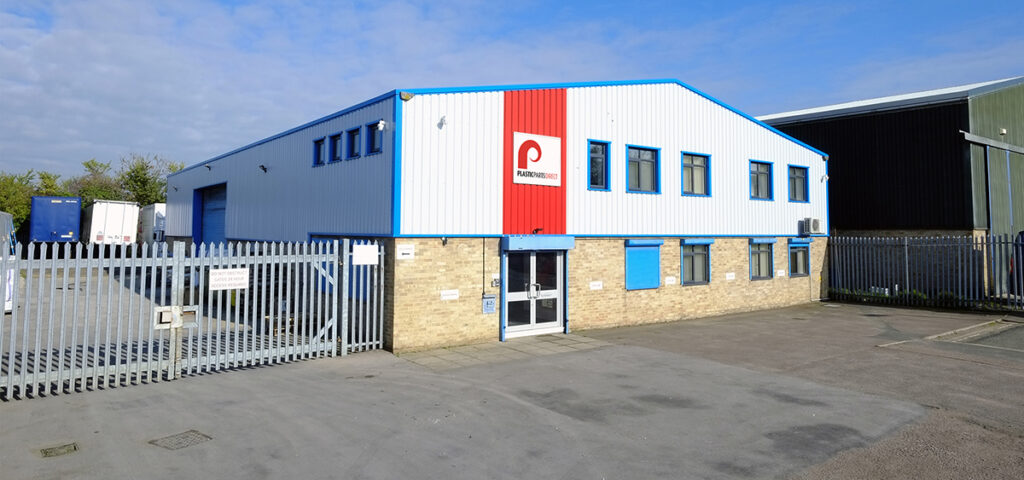
In this issue of Industrial Process News, we are pleased to feature Plastic Parts Direct as our Injection Moulding Company of the Month.
 In plastic injection moulding, the problems that cause the most disruption are often the ones customers don’t even know exist until it’s too late. Speaking to Nick Cook, who works in Business Development at Plastic Parts Direct, it quickly becomes clear that much of this comes down to one thing: design for manufacture.
“People tend to focus on the tool,” he explains, “but that’s only part of it. If the design hasn’t been properly thought through for manufacture, that’s when costs start creeping up.” It’s a point that comes up repeatedly. Details like wall thickness, material use and even how a part will sit within a mould all have a direct impact on cost and efficiency.
“You can reduce tool complexity, control material usage and make the whole process more efficient just by getting the design right at the start,” he says. “Even something like matching the tool to the right machine can make a big difference.”
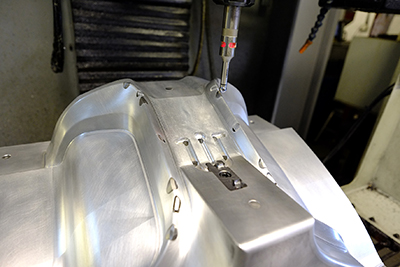
It also feeds into one of the biggest misconceptions he sees. “A lot of people assume injection moulding is expensive because of the tooling,” Nick says. “But if it’s done properly, it doesn’t have to be.” Plastic Parts Direct builds this thinking into its process from day one, offering full DFM support and using standard mould bases alongside UK-designed tools and in-house tooling, with one simple aim, to keep costs under control while still delivering a reliable, scalable solution.
A recent project highlights the effectiveness of this approach. A manufacturer of LED lighting for harsh environments needed a cap to secure the end of a diffuser and prevent insects getting inside. “It sounded simple,” Nick says, “but it still needed to work properly in a tough environment.” The team developed two options and produced 3D-printed samples so the client could test the fit before committing. “Once they were happy, we moved straight into tooling,” he adds. Using a four-cavity insert within a standard base, the full solution was delivered in just six weeks.
Nick also points to the growing influence of 3D printing on customer expectations. “We’re seeing more designs come through that work perfectly for 3D printing, but not for moulding,” he says. Features like undercuts or angled holes might not seem like an issue at first, but in tooling, they can quickly double the cost. “That’s where clients are relying on us more,” he adds, “to guide them towards a design that still does the job, just in a much more cost-effective way.”
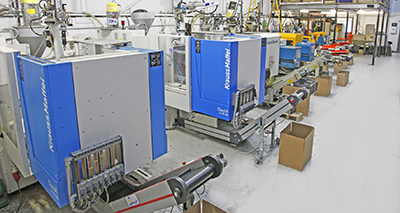 Plastic Parts Direct stays competitive by working closely with material suppliers and investing in energy-efficient processes that reduce waste. “We use closed-loop recycling where possible, reprocessing sprues and start-up scrap, and make sure the right tooling runs on the right machine to balance speed, quality and cost,” says Nick.
Flexibility is another key strength. As a privately owned business with a dedicated team, staff will go the extra mile to keep production moving. With in-house tooling maintenance, automation for complex parts and ongoing investment in modern, efficient machines, the company ensures consistent quality while keeping costs under control.
As the conversation turns to the future, Nick is clear that sustainability is central to how Plastic Parts Direct operates. “It plays a huge role for us,” he says. “We’ve invested in the latest machines that use less energy, we’ve got energy-efficient lighting throughout, and we recycle wherever we can. It’s about keeping control of our environmental impact.” But he’s also open about the bigger picture. “There’s a perception that sourcing overseas is cheaper and therefore better, but if you’re moulding parts in a country with less regulation and then shipping them halfway around the world, the carbon footprint is significantly higher. Keeping production in the UK is often the greener option.”
 Looking ahead, however, he sees challenges on the horizon, particularly around energy. “If you look at the push towards net zero and the rising cost of electricity, there’s a real risk we will price UK manufacturing out of the market,” he says. “Then production just moves abroad. You’re not reducing carbon emissions, you’re just moving them somewhere else, often to countries that pollute more, giving a net increase.”
“Plastic parts direct constantly look at ways to reduce energy usage and cut unnecessary costs in production to ensure we are competitive for our clients and are ready for the future, this gives stability of supply to our clients.”
Against that backdrop, Nick is keen to highlight what Plastic Parts Direct does best. “For us, it’s the full service: design, tooling and moulding,” he says. “That’s where we add the most value, working with clients from the very start to get things right.”
Ultimately, though, it comes back to relationships. “We see ourselves as a partner,” he adds. “We genuinely care about our clients and what they’re trying to achieve. We understand the pressures, especially for SMEs, and sometimes that means going above and beyond. If something’s gone wrong and a customer needs parts urgently, we’ll do what it takes, even if that means getting in the car and delivering them ourselves. At the end of the day, we’re here to keep their production running.”
For more information, please see below:
T 01295 269333
sales@plasticpartsdirect.co.uk
https://www.plasticpartsdirect.co.uk