

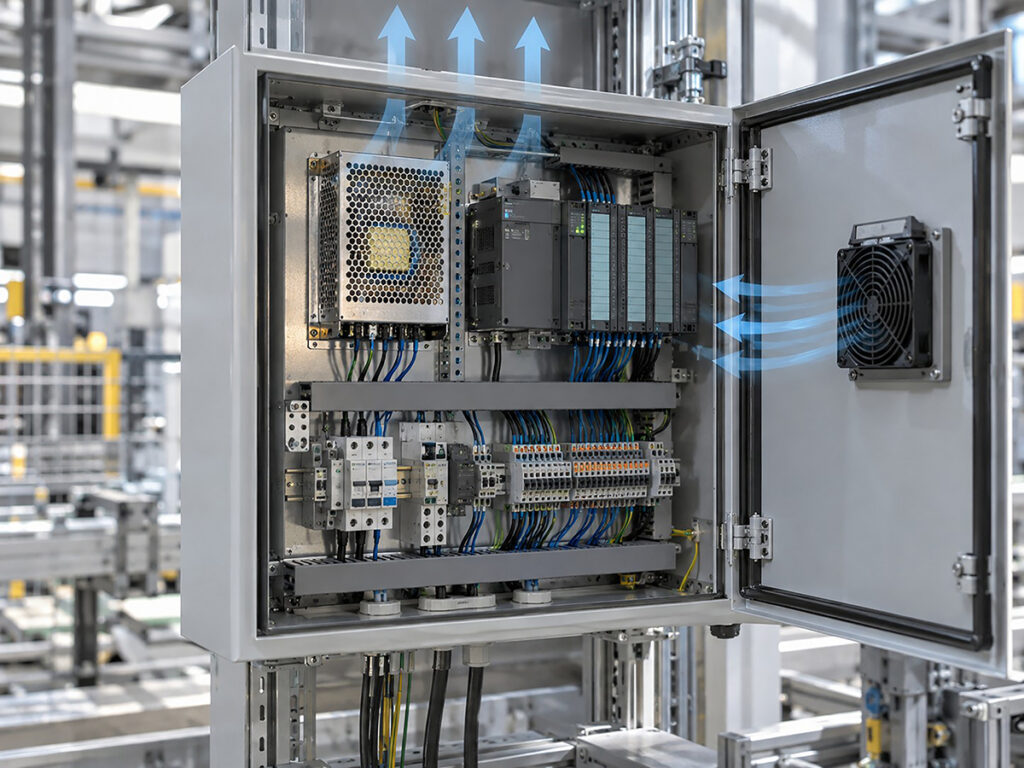
Unexpected downtime in an industrial control system is rarely caused by one dramatic failure. More often, it develops from smaller electrical, thermal or installation problems that gradually reduce power-system reliability.
 PLCs, sensors, relays, HMIs and communication devices depend on stable DC power. In many industrial systems, 24 VDC is widely used for control circuits. If the supply becomes unstable, overloaded or overheated, the symptoms may appear elsewhere: intermittent resets, communication faults, unexplained alarms or complete shutdowns.
For maintenance teams, machine builders and system integrators, power-supply checks should therefore form part of preventive maintenance. The following five checks can help identify problems before they become production downtime.
1. Check the real load, not only the nameplate rating
A power supply should not be selected only by adding together the nominal wattage of connected devices. Industrial loads change during operation. Solenoids may energise, relays may switch, actuators may start and additional I/O devices may become active. These events can create current peaks significantly above the normal running load.
A system that looks comfortable during steady-state operation may therefore approach or exceed the power supply limit during startup or switching. Engineers should compare actual operating current with rated output and leave reasonable reserve for transient loads, future expansion and component ageing.
Where a machine uses a 24 V architecture, the complete 24V open-frame power supply design should consider steady current, start-up behaviour, wiring voltage drop, enclosure conditions and load behaviour rather than treating nominal voltage as the only design parameter.
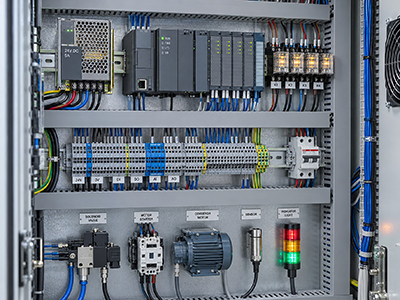
Where possible, measure the DC load under several operating conditions rather than relying only on design documentation.
2. Verify the Input Power Conditions
The output of a DC power supply is only as reliable as the AC input feeding it. Industrial facilities can present challenging conditions, including voltage dips, switching events and disturbances created by large motors or other equipment sharing the same network.
Technicians should confirm that the AC input remains within the specified operating range. Loose terminals and poorly secured connections should also be checked because increased resistance can create local heating and voltage drop even when the supply itself is functioning correctly.
When unexplained control-system resets occur, checking only the DC output may miss the original cause. Input wiring, protective devices, terminal condition and upstream voltage behaviour should all form part of the inspection.
3. Check temperature, airflow and derating
Heat is one of the most important factors affecting power-supply reliability. A unit mounted inside a control enclosure does not necessarily operate at room temperature. Cabinet temperatures may be much higher because of PLCs, drives, relays and communication equipment.
Cooling conditions can also change over time as filters become blocked, fans deteriorate or additional equipment is installed. Many power supplies can provide full rated output only within specified thermal and airflow conditions. Above that range, output capacity may need to be reduced according to the manufacturer’s derating requirements.
Open-frame supplies make enclosure design particularly important because airflow, mounting, clearance and nearby heat sources all affect the operating environment.
For example, the GW-TO70WV12 open-frame power supply is intended for compact industrial control, embedded and communication applications where installation layout and airflow need to be considered as part of system integration.
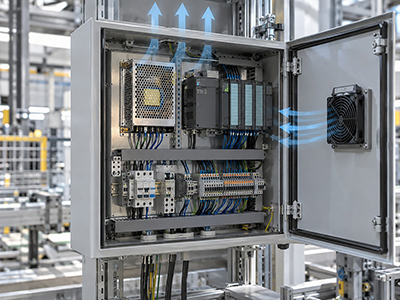
Check that ventilation openings are clear, airflow is not blocked and adequate spacing is maintained around heat-sensitive components.
Temperature-related faults deserve particular attention when a machine works normally when cold but becomes unstable after several hours.
4. Review redundancy and power distribution
For applications where downtime is costly, a single power supply may represent an unnecessary single point of failure. Redundant architectures can provide additional protection by allowing another power source or path to continue supporting critical loads if one source becomes unavailable.
However, installing two supplies does not automatically create a reliable redundant system. The design should consider output isolation, current sharing where applicable, distribution modules, wiring capacity, protection and system behaviour after one supply or input path fails.
Distribution should also be checked beyond the power supply itself. A healthy DC source cannot prevent downtime caused by a poor downstream connection, overloaded terminal block, damaged conductor or excessive cable resistance.
Voltage at the power-supply terminals may appear normal while equipment further along the distribution path experiences excessive voltage drop. For critical loads, checking voltage at the actual device can reveal problems invisible at the source.
5. Inspect for early signs of deterioration
Power-supply maintenance should not begin only after failure. Visual and electrical inspections can often reveal warning signs before production is affected.
Technicians should look for discolouration around terminals, abnormal heat, damaged wiring, loose connections, unusual fan noise, contamination and signs of component stress. Output voltage should also be checked for stability, particularly where sensitive PLC or communication equipment is involved.
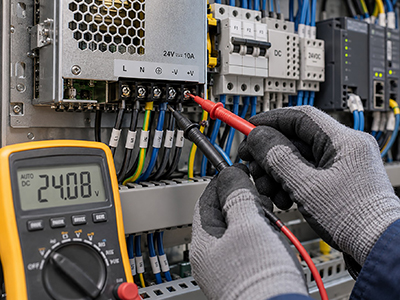
Where monitoring functions are available, operating data and alarms can provide information about output current, temperature and abnormal conditions. Maintenance records are also valuable. Repeated faults may reveal a pattern linked to load changes, temperature or specific equipment.
A power supply should be treated as part of the system
Industrial power reliability depends on more than choosing a unit with the correct voltage and wattage. Load behaviour, AC input conditions, cabinet temperature, wiring, distribution and redundancy all influence whether a control system continues operating reliably.
As industrial equipment becomes more connected and dependent on electronics, a brief interruption may affect PLC logic, networking, monitoring and automated production simultaneously.
For this reason, power-supply selection and maintenance should be treated as part of the complete control-system design rather than as an isolated component decision.
Powernexu works with server and industrial power applications including open-frame AC-DC power supplies, redundant power systems and related power-distribution solutions. Matching the power supply to the electrical, thermal and mechanical requirements of the application can help OEMs, integrators and industrial users reduce avoidable reliability problems.
T +852 30697751
sales@powernexu.com
https://powernexu.com